Thursday, March 5, 2009

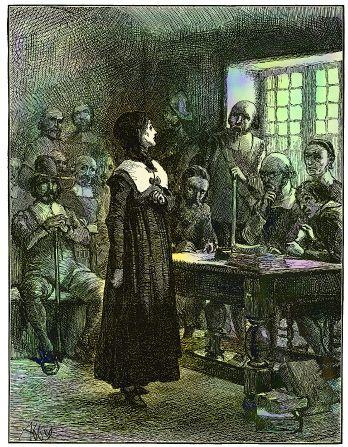
EXCERPT: Anne Hutchinson (Posted by Carolina Arana)

"Gov. You know that there is no rule that crosses another, but this rule crosses that in the Corinthians. But you must take it in this sense that elder women must instruct the younger about their business, and to love their husbands and not to make them to clash.
Mrs. H. I do not conceive but that it is meant for some publick times.
Gov. Well, have you no more to say but this?
Mrs. H. I have said sufficient for my practice.
Gov. Your course is not to be suffered for, besides that we find such a course as this to be greatly prejudicial to the state, besides the occassion that it is to seduce many honest persons that are called to those meetings and your opinions being known to be different from the word of God may seduce many simple souls that resort unto you, besides that the occassion which hath come of late...it will not well stand with the commonwealth that families should be neglected for so many neighbours and dames and so much time spent, we see no rule of God for this, we see not that any should have authority to set up any other exercises besides what authority hath already set up and so what hurt come of this you will be guilty of and we for suffering you.
Mrs. H. Sir I do not believe that to be so.
Gov. Well, we see how it is we must therefore put it away from you, or restrain you from maintaining this course.
Mrs. H. If you have a rule for it from God's word you may.
Gov. We are your judges, and not you ours and we must compel you to it." (316)

Image Source: “Anne Hutchinson: founded Portsmouth.” Photo. WordAtlas.com 5 March 2009. <http://www.worldatlas.com/webimage/countrys/namerica/usstates/aaposter/riannehutchinson.jpg>.
Text Source: "The Antinomian Controversy, 1636-1638." Ed. by David D. Hall. Duke University Press: Durham and London, 1990.

EXCERPT: Martha Milcah Moore's Commonplace Book (Posted by Steve Acquaviva)

“A Letter of Farewell from a Gent. to a young Woman whom he had long paid his Addresses to in vain.—"

“All Passions (as some Casuists opine)
Grow with their like, with their reverse decline—
Ambition, thus, but fans ambitions Fire,
And mild Affections, thro” Contempt, expire—
The Instance follows—she who once cou’d move,
Within my Bosom every Source of Love;
Whose magic Face with Joy or Fear assaild,
My captive Heart, as Smiles or Frowns prevail’d,
The Influence of whose fascinating Eye,
Cou’d bid me hope, despair, even live or die—
Tho’ still all-graceful—now no longer fires,
With jealous Rage, or melts with soft Desires—
For lost their Power—even Beauties still the same,
No more revive the extinguish’d Lovers Flame,
Who now unmov’d, surveys her Hoard of Charms,
Unmov’d, can hear them doom’d to other Arms,
Nor feels one Pang, nor breaths a secret Sigh,
Whether she Hymens social Fetters try,
Or unadmir’d live on to stale Virginity.—
Learn here, coy Nymph! in this reverse of Things!
How short the Empire, which from Beauty springs:
Had but they Breast with mutual Ardour beat,
Love yet had kept his abdicated Seat,
Still had they Charms their wonted Force retain’d,
Still in my Soul unrival’d thou hadst reign’d,
And long e’er this, restrictive nuptial Bands,
As Choice our Hearts, had join’d our plighted Hands,
Unhappy Sex!—Let this Example prove,
How close Indiff’rence follows slighted Love;
Repuls’d, how soon the offended God departs,
And stirs Rebellion in yr. Subjects Hearts,
Unless Complaisance fly to Beauty’s Aid,
And fix the Conquests which her Charms have made.
Adieu, my Fair!–& may a happier Fate
If more deserv’d, yr. future Lovers’ wait;
For me kind Heave some yielding Nymph ordain,
Who tho’ less fair, has less Delight in Pain” (186-87).

Source: Moore, Milcah Martha. Milcah Martha Moore’s Book: A Commonplace Book from Revolutionary America. Ed. Catherine La Courreye Blecki and Karin A. Wulf. University Park, PA: Penn State University Press.

EXCERPT: Elizabeth Ashbridge (2) (Posted by Carolina Arana)

"...and from that time for several months I was in utmost Despair, and if any time I would endeavour to hope or lay hold of any Gracious promise, the old Accuser would Come in, telling me, it was now too Late, I had withstood the day of Mercy till it was over, & that I should add to my Sins by praying for Pardon & provoke Divine Vengeance to make a Monument of Wrath of me. I was like one already in torment; my Sleep Departed from me, I Eat little, I became extremely melancholy, and took no delight in any thing. Had all the world been mine & the Glory of it, I would now have Gladly a given it for one glimpse of hope; My husband was Shock'd, to See me so changed, I that once Could divert him with a Song (in which he greatly delighted), nay after I grew Religious as to the outward, could now Do it no longer. My Singing now was turned into mourning & my Dancing into Lamentations: my Nights and Days were one Continual Scene of Sorrows: I let none know my Desperate Condition - My husband used all means in his power to divert my Melancholy, but in vain, the wound was too Deep to be healed with any thing short of the true Balm of Gilead. I Durst not go much alone for fear of Evil Spirits, but when I did my husband would not suffer it, & if I took the Bible, he would take it from me saying, 'how you are altered, you used to be agreeable Company but now I have no Comfort of you.'I endeavoured to bear all with Patience, expecting soon to bear more than man could inflict upon me" (156-157).

Source: Ashbridge, Elizabeth. "Some Account of the Fore Part of the Life of Elizabeth Ashbridge." Journeys in New Worlds: Early American Women's Narratives. Ed. William L. Andrews, Sargent Bush, Jr., Annette Kolodny, Amy Schrager Lang, and Daniel B. Shea. Madison, WI: The University of Wisconsin Press, 1990.

EXCERPT: Mary Rowlandson (Posted by Novi Peroldo)

"But, to Return: we travelled on till night, and in the morning, we must go over the River to Phillip's Crew. When I was in the Cannoo, I could not but be amazed at the numerous Crew of Pagans that were on the Bank on the other side. When I came ashore, they gathered all about me, I sitting alone in the midst; I observed they asked one another Questions, and laughed, and rejoyced over their Gains and Victories; then my heart began to faile; and I fell a-weeping..." (42).

Source: Rowlandson, Mary. "The Captivity and Restoration of Mrs. Mary Rowlandson". Journeys in New Worlds: Early American Women's Narratives. Ed. William L. Andrews, Sargent Bush, Jr., Annette Kolodny, Amy Schrager Lang, and Daniel B. Shea. Madison, WI: The University of Wisconsin Press, 1990.

EXCERPT: Elizabeth Ashbridge (1) (Posted by Novi Peroldo)

"...Here [my husband] took me to a Tavern where I soon became the Spectacle & discourse of the Company. My Husband told them, "my wife is a Quaker," & that he Designed if Possible to find out some Place where there was none. "O," thought I, "I was once in a Condition deserving that name, but now it is over with me. O! that I might from a true hope once more have an Opportunity to Confess to the truth;" tho' I was Sure of Suffering all manner of Crueltys, I would not Regard it.

These were my Concerns while he was Entertaining the Company with my Story, in which he told them that I had been a good Dancer, but now he Could get me niether to Dance nor Sing, upon whiche one of the Company stands up saying, "I'll go fetch my Fiddle, & we'll have a Dance," at which my husband was much pleased. The fiddle came, the sight of which put me in a sad Condition for fear if I Refused my husband would be in a great Passion: however I took up this resolution, not Comply whatever be the Consequence. He comes to me, takes me by the hand saying, "come my Dear, shake off that Gloom, & let's have a civil Dance; you would now and then when you was a good Churchwoman, & thats better than a Stiff Quaker." I trembling desired to be Excused; but he Insisted on it, and knowing his Temper to be exceeding Cholerick, durst not say much, yet did not Consent. He then pluck'd me round the Room till Tears affected my Eyes, at Sight, whereof the Musician Stopt and said, "I'll play no more, Let your wife alone," of which I was Glad" (162).

Source: Ashbridge, Elizabeth. "Some Account of the Fore Part of the Life of Elizabeth Ashbridge...". Journeys in New Worlds: Early American Women's Narratives. Ed. William L. Andrews, Sargent Bush, Jr., Annette Kolodny, Amy Schrager Lang, and Daniel B. Shea. Madison, WI: The University of Wisconsin Press, 1990.